

Designing a child's bedroom is one of the more enjoyable briefs in interior design, but it comes with a challenge that adult spaces do not: children change their minds. Fast. The dinosaur obsession that defined the room at age five is ancient history by age eight, and what worked for a toddler rarely survives primary school intact.
The solution is not to design for right now. It is to design a room that is flexible enough to grow and change alongside your child without requiring a full redecoration every few years. Here are five practical ideas that make that possible.
The most future-proof approach to colour in a child's bedroom is to keep the majority of walls neutral and concentrate the personality on a single feature wall. A neutral base in a warm white or soft greige means the room never feels dated and works with almost any colour palette as your child's tastes evolve.
The feature wall is where you have fun. Choose a wallpaper that reflects your child's current interests, or opt for a more interactive option such as a chalkboard paint wall or a wallpaper designed for drawing on. Both give children a creative outlet in their own space and are easily updated when tastes change. Dulux has a chalkboard paint range that works well on a single wall and can be repainted over when your child is ready to move on.
The best furniture in a child's bedroom does more than just occupy space. A chalkboard table, a reading nook with built-in cushions, or a low desk designed for drawing and making gives children a reason to engage with their room and use it actively. Pieces like these tend to stay relevant across a wider age range than themed furniture, which can feel babyish surprisingly quickly.
When selecting furniture, prioritise durability alongside function. Children are not gentle with their belongings, and pieces that can withstand daily use without looking worn are worth the investment. Solid timber, powder-coated metal, and easy-clean surfaces all hold up well in a child's room over the long term.

Hard floors or neutral carpet are the right foundation for a child's bedroom. They are easier to clean, more durable, and provide a blank canvas that works with any colour scheme. The personality and warmth come from a rug layered on top, which can be swapped out easily and cost-effectively as tastes change.
A rug also defines the play area within the room, which is useful in both small and larger spaces. Choose one in a colour or pattern that anchors the current palette of the room, knowing that replacing it in a few years is a simple and affordable update rather than a major commitment. Armadillo offers natural fibre rugs in a range of sizes and tones that work well in children's rooms and are durable enough for daily play.
Children accumulate artwork, posters, ribbons, photographs, and memorabilia at a remarkable rate, and how you display it matters as much as what you display. Rather than pinning directly to walls, which causes damage and limits flexibility, consider a dedicated display system that can be refreshed without repainting.
Cork boards in simple frames, wire display systems with clips, or a picture rail with hanging hooks all allow images and artworks to be rotated regularly without any wall damage. Frame a collection of your child's own drawings in matching frames for a cohesive look that is also genuinely personal to them. As interests change, the display changes with them.
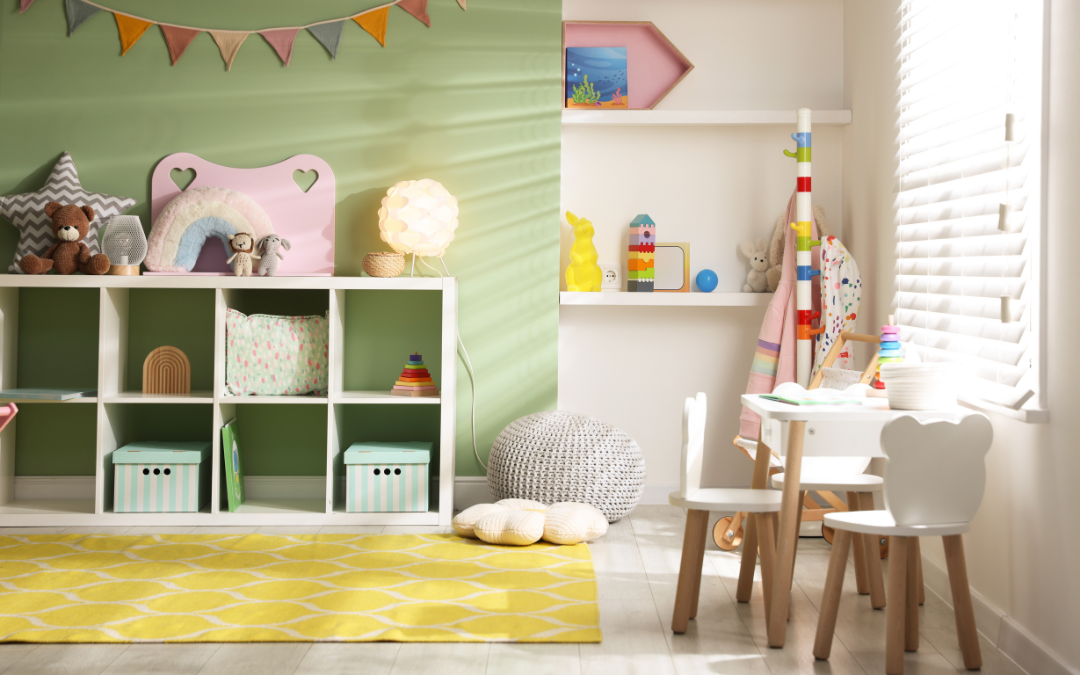
Storage is the single most important factor in keeping a child's bedroom functional and calm, and it needs to be planned for every stage of childhood rather than just the current one. Toddlers need accessible, low storage for toys. School-age children need space for books, craft supplies, and sporting equipment. Teenagers need somewhere for technology, clothing, and the general accumulation of a busy social life.
The most flexible approach combines built-in storage, such as shelving and wardrobes that will serve the room for years, with moveable pieces that can be repositioned or replaced as needs change. Under-bed storage on castors is particularly useful: it keeps the floor clear and makes use of space that would otherwise go to waste. Floating shelves are another practical solution, adding storage without taking up floor space in rooms where every square metre counts. Bunnings carries a solid range of modular shelving and storage systems that can be configured to suit different room sizes and ages.
The best children's bedrooms are not the ones that look the most impressive in photos. They are the ones that children actually want to spend time in, that grow and change alongside them, and that do not need to be torn apart and started again every few years.
By building flexibility into the foundations, neutral walls, durable floors, adaptable storage, and a display system that can be refreshed easily, you create a room that serves your child well from the early years right through to adolescence.
If you would like help designing or refreshing a child's bedroom, get in touch. It is one of the most rewarding briefs we work on.


